
Groundwater has been in the news in Napa of late. Ever since passage of the Sustainable Groundwater Management Act (SGMA) in 2014, Napa County has been working to get a better handle on the way we use groundwater. This summer the County plunged into an intensive process to develop a Groundwater Sustainability Plan for the Napa Valley subbasin of the Napa River watershed, which is scheduled to be complete in November 2021 – just over a year from now.
If you haven’t thought a lot about groundwater, you’re not alone. Even if you have a well, you may be fairly sketchy on how water moves into, through and out of the ground we walk on. The basic fact is that the earth has a fairly porous surface, and rainwater that doesn’t run off or evaporate must soak in. That water collects in geologic formations that have significant pore space for holding water, which are called aquifers – water bearing formations.
Water in the ground is always trying to find its own level, responding to gravity just as it does on the earth’s surface, except that groundwater moves much more slowly – after all, it’s moving through a solid medium. The medium becomes saturated below a certain level, which is called the water table. And what happens around rivers and other surface water bodies is interesting; the water table may be higher or lower than the river, and water will flow from one to the other through the river bed and banks. See diagram 1
Diagram 1
Here’s a diagram of the situation when the groundwater table is higher than the river.
As you might imagine, water will flow into the river, which we then call a gaining stream. Diagram 2 shows the opposite, a losing stream.
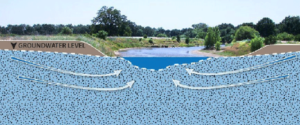
Diagram 2
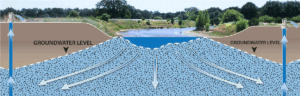
So we see that flow in our Napa River may well be related to groundwater levels around it, and in fact one element of the monitoring program being developed for the County will focus on the interconnected surface and groundwater network. We are following this process with interest. Thanks to the Nature Conservancy for the use of their visuals.
Bob Zlomke